
Manitowoc Previous-Resident Sources
No source spans every era or proves both ownership and occupancy. Start with the record closest to the date in question. Then cross-check it against a source created for another purpose. Recent work begins with a parcel card and deeds. Early twentieth-century work often begins with directories, census schedules, maps, and newspapers.
| Source | Years covered | Where held | What it can show |
|---|---|---|---|
| LandWeb / ColorTract | Electronic index reported from 1987-02-04 | Register of Deeds | Recorded parties, dates, instruments, title trail |
| City and county directories | MCHS from 1864; MPL digital 1868–1920, with gaps | MPL and MCHS | Names, addresses, street sections, local listings |
| Federal census | Public schedules through 1950 | Library databases and federal collections | People grouped as a household on census day |
| Sanborn maps | 1883 set has nine sheets | Library of Congress | Building footprint and street context |
| Permits | Current system; historic span not established | City Building Inspection | Dated work, site, owner or applicant |
The dates are coverage guides, not promises that a specific year survives. MPL's digital directory run is not annual. The Register of Deeds counter is needed when the electronic index ends or an image is unavailable. MCHS can search a person, family, or property when given names, dates, places, and a focused question.
Start a Manitowoc Address History
Use the City of Manitowoc Ascent search for a current city parcel. County Ascent is incomplete for current City of Manitowoc ownership unless a delinquent balance exists. Copy the owner field, site address, mailing address, parcel ID, legal description, privacy flag, and tax year. Keep the owner and mailing fields separate from evidence of residence.
A parcel is the tax and GIS unit. It may not match one building or one old lot throughout time. Split or combined parcels, corner lots, and address changes can break a simple name search. The legal description is the stable bridge because it describes the titled land rather than merely its current mail label.
Trace Manitowoc Past Owners Backward
The Manitowoc County Register of Deeds holds recorded land documents. Its index can establish title interests and transfers. It does not establish who occupied a home. Use the current parcel facts to build the chain one instrument at a time.
- Copy the current owner's full indexed name and the parcel's legal description.
- Search that owner as grantee, meaning the receiving party, to locate the purchase deed.
- Read the deed for the grantor, meaning the transferring party, plus date and document or book/page number.
- Search that grantor as a grantee and repeat while the online index supports the trail.
- When the reported 1987 cutoff is reached, contact Room 107 for older tract books, deed books, images, and certified copies.
- Grantor / grantee
- The party transferring an interest and the party receiving it.
- Chain of title
- The linked series of recorded transfers for the same land.
- Legal description
- The lot, block, subdivision, survey, or metes-and-bounds identity used in title records.
Mortgages, satisfactions, releases, liens, easements, plats, and judgments can explain a gap but may not represent a sale. Record every instrument number. If exact wording matters, request the document instead of relying only on the index.
The successful capture of ColorTract shows the county-linked tract and scanned-record route.
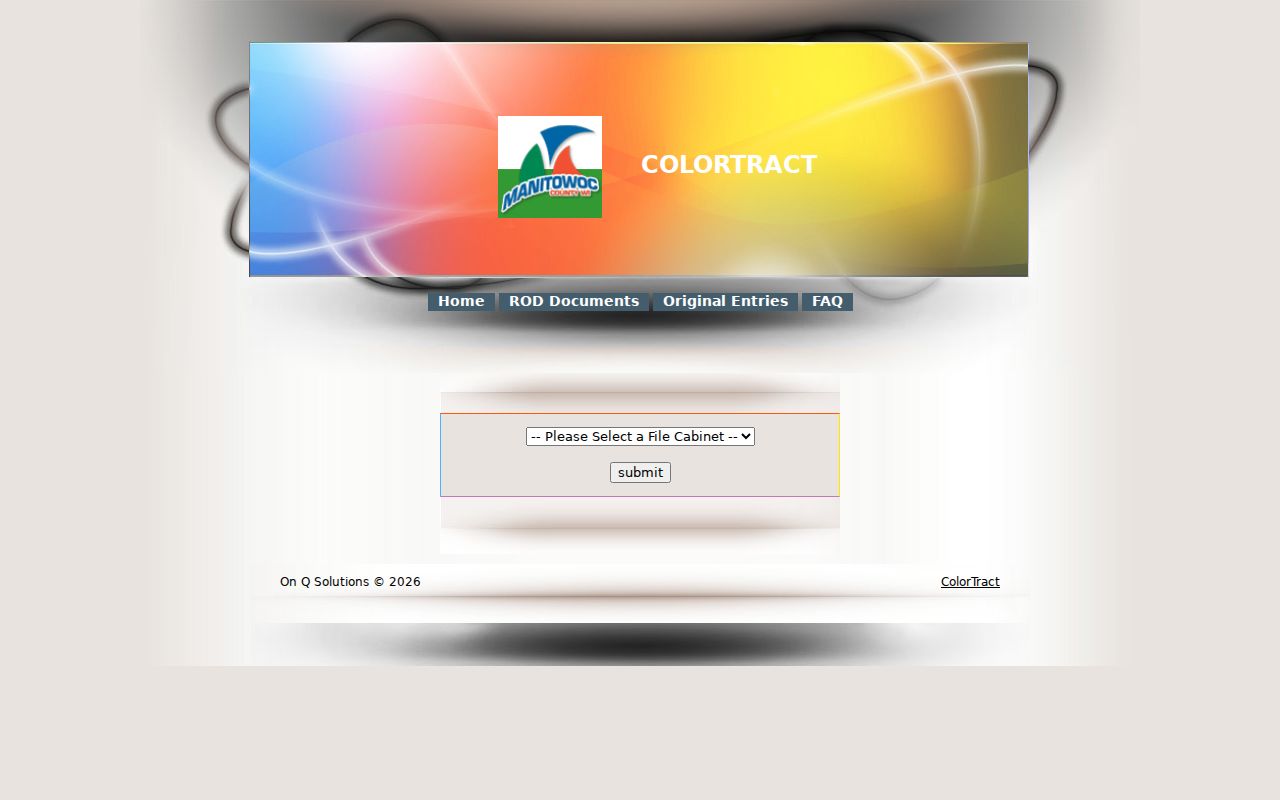
The interface marks the electronic doorway; older title evidence still may require staff help and physical books.
When Manitowoc Address Records Stop
The tract index is reported online from February 4, 1987, and data uploads nightly. Full images and printing may depend on current subscription terms. Call 920-683-4012 before relying on an image cutoff. The Register of Deeds is in Room 107 at 1010 South 8th Street, open Monday 8:30 a.m. to 5 p.m. and Tuesday through Friday 8:30 a.m. to 4:30 p.m.; document recording ends at 4 p.m.
Ask for a tract, grantor-grantee, document-number, or book-and-page search tied to the legal description. Staff cannot draft documents or give legal advice. A certified copy comes from the custodian, while a portal image is a research aid. Wisconsin Public Records Law also supports a focused request that states the record, parcel, date span, and delivery format.
Map Manitowoc Address Eras
A backward address trail needs an era map. Manitowoc's original plat was recorded in 1851, and the city incorporated in 1870. The first county courthouse at Manitowoc Rapids burned in 1852; voters moved the county seat to Manitowoc in 1853. Early material may therefore use Manitowoc Rapids, an old plat reference, or a lot-and-block description instead of a modern street number.
The 1883 Sanborn fire-insurance map set has nine sheets. Compare building footprints, street labels, and lot context with deeds and directories. No official citywide renumbering table was located, so a changed number must be demonstrated from maps, plats, directories, or permits rather than guessed.
Note: A legal description usually survives an address change better than a street name, ZIP code, owner name, or mailing address.
Pair Manitowoc Resident Records
The MPL digitized directory collection spans 1868–1920 in irregular runs. The 1909–1910 and 1911–1912 volumes include street sections and alphabetical names. MCHS reports physical directories from 1864. These sources can identify address-linked names that do not appear in the deed chain.
- Choose a directory year near the event or deed date.
- Find the street section and scan the numbered address, allowing for old spellings and number changes.
- Check each name in the alphabetical section for spouse, widow, address, or other notation actually printed.
- Compare the nearest public census schedule, which can show the household as recorded on census day.
- Move to the next directory year and log additions, departures, and uncertain gaps.
The scans must be checked visually because item metadata does not prove which fields appear in a particular entry. Rural addresses call for Zorn's 1905 Rural Routes Directory, arranged by numeric routes and alphabetical mail recipients. The collection itself is covered in depth on the Manitowoc city directory page.
Get Manitowoc Address-History Help
The Manitowoc Public Library house-history guide connects deeds, directories, census records, maps, newspapers, and photographs. MPL also holds newspaper microfilm from the 1850s, local name and place indexes, an obituary index, census microfilm, and local-history databases. These channels fill gaps when an address is not searchable online.
The Manitowoc County Historical Society accepts focused research requests and asks for a person, family, or property plus names, dates, locations, and the question. The stated turnaround is two to four weeks. Research is free for members, students, media, and nonprofits; otherwise it is $15 per hour with a one-hour minimum. Confirm current terms before ordering.
The manifest's MCHS archive page capture represents this offline research layer.
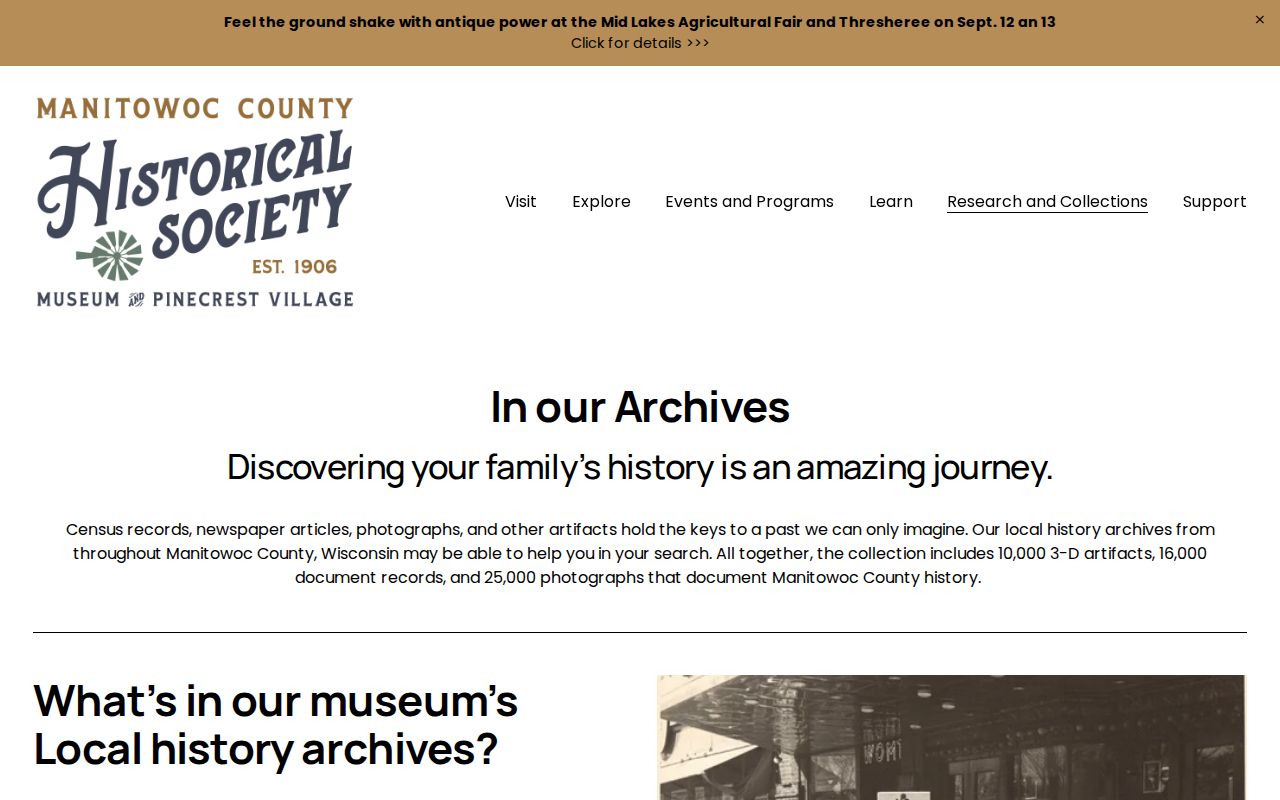
Its breadth helps explain why a missing web result does not end a Manitowoc house-history search.
Close Manitowoc Resident Trails
Obituaries, cemetery records, and probate can explain what happened after a past resident left an address. MPL's obituary and death-notice index points researchers to newspaper microfilm. MCHS holds cemetery lists, early newspapers, church records, immigration material, and family files. An index citation is only a pointer; retain the newspaper date, page, and column and then read the article.
Register in Probate keeps estates, wills, guardianships, conservatorships, and related files. FamilySearch has digitized Manitowoc probate material for 1850–1923 from Wisconsin Historical Society originals. Access can vary by image and account. Search by a confirmed name and approximate death date, then compare heirs, property descriptions, and filing dates with the address timeline.
Manitowoc Past Households and Limits
Previous residents are best supported by agreement among sources. A deed proves a recorded interest. A directory prints a dated listing. A census records a household on one day. A permit ties work and named parties to a site. An obituary or probate file may connect relatives and a prior home. None should be stretched beyond its purpose.
Tax-roll mailing addresses are not occupancy proof. Public voter data omits unregistered people and protects confidential fields. Safe at Home participants can use assigned addresses. Do not publish protected information or repeatedly contact a living person because an old record associates them with a house.
Lawful use. Research Manitowoc past residents for family history, estate work, and property history. Wisconsin stalking and harassment laws, Wis. Stat. §§940.32 and 947.013, remain in force.