
Manitowoc Directory Years and Shelves
The historical shelf is split between two main custodians. The Manitowoc Public Library digital collection describes thirteen items spanning 1868 through 1920. It is not an annual run, so a missing year cannot be treated as evidence that a person left town. The Manitowoc County Historical Society archives report city and county directories beginning in 1864, four years earlier than the first item now listed online. That comparison matters when a family appears in early county records but not in the digital shelf.
| Manitowoc collection | Years represented | Repository | How to use it |
|---|---|---|---|
| City and county directories | Begins 1864 | Manitowoc County Historical Society | Archives or a focused research request |
| Digitized city and county directories | 1868-1920, with gaps | Manitowoc Public Library | Free item pages and scans online |
| Zorn's Rural Routes Directory | 1905 | Manitowoc Public Library | Route number or recipient name |
| Manitowoc and Two Rivers directories | 1907-1908 | Manitowoc Public Library | Digitized collection |
| Street and alphabetical directory runs | 1909-1910 and 1911-1912 | Manitowoc Public Library | Browse both sections in each scan |
The listed volumes include 1868, 1875-1876, 1880, 1884, 1901, 1905, 1907-1908, 1909-1910, 1911-1912, and 1920. The metadata verifies each volume's date and general scope, but not every field printed in every entry. Read the scan and its abbreviation page before drawing a conclusion. Later phone books and other directory material may be available on site even when no web item appears.
The scope also changes by edition. A city-only book, a combined Manitowoc and Two Rivers volume, a city-and-county edition, and a rural-route list do not describe the same population. Write the full title beside every citation. That habit prevents a county recipient from being mistaken for a city resident and makes the search reproducible for another family researcher.
Browse Manitowoc Directories Online
Each digital item has a landing page with descriptive metadata and a file object. The 1868 Manitowoc directory item is a useful place to learn the viewer before opening later volumes. Search tools may expose metadata rather than every word printed on a page. When text search fails, browse the alphabetical sequence manually and note the scan page as well as the printed page.
The linked view shows how the library presents one early Manitowoc volume online.
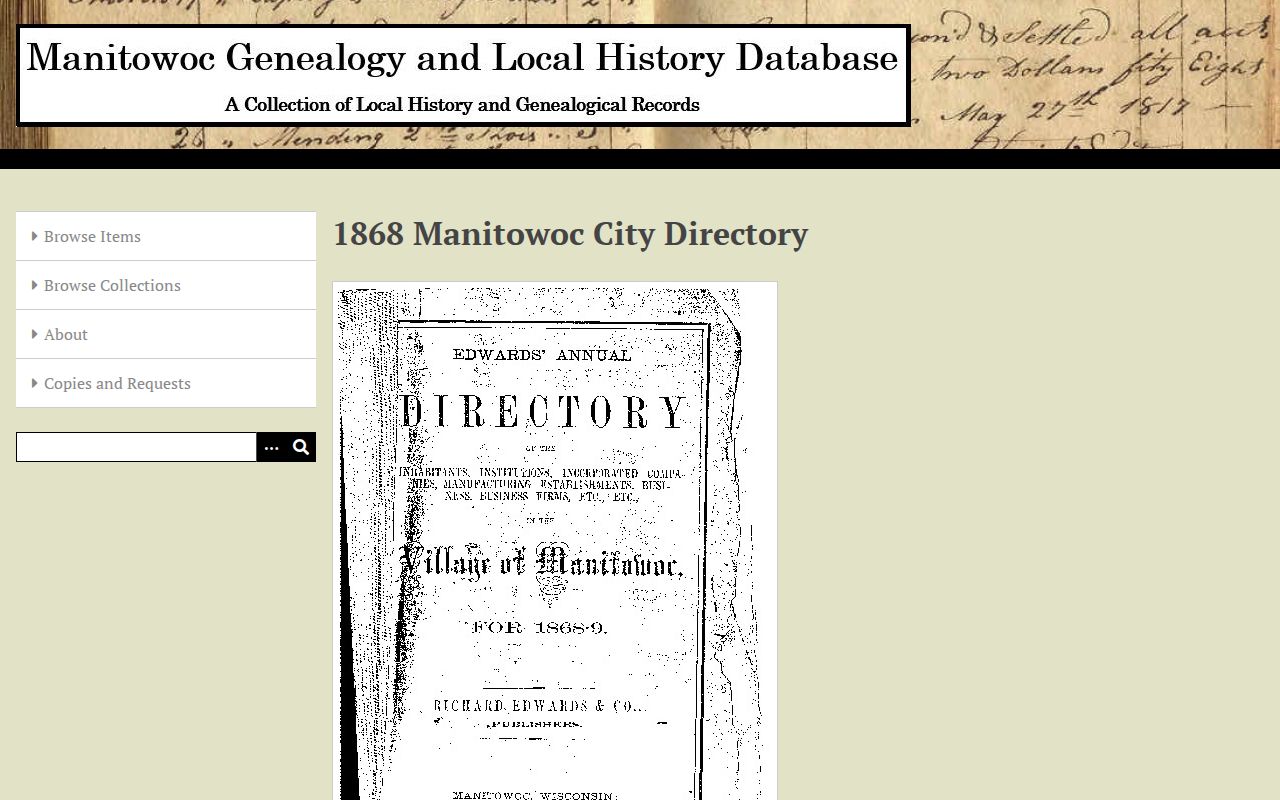
A result on that landing page is the doorway to the volume, not a verified transcription of a resident entry. Open the page image and preserve original spelling.
Manitowoc Rural Route Directory
Zorn's 1905 Rural Routes Directory of Manitowoc and Calumet Counties does not follow only the city grid. Its metadata describes numeric rural routes and an alphabetical list of mail recipients. Search a rural ancestor by surname and route number, then compare the result with township records, plats, census pages, and later street addresses. A modern city-address search may miss that earlier form of delivery entirely.
This volume also warns against treating “Manitowoc” as a fixed boundary. City, county, village, and rural-route references can sit beside one another in local records. Retain the community name and route as printed. They may be the best bridge to a farm parcel or church register.
Note: A rural-route number is a mail path, not a modern parcel number or proof of ownership.
Read a Manitowoc Directory Entry
The 1909-1910 and 1911-1912 metadata confirms both street and alphabetical name sections. Use the street section to locate a numbered address, then confirm the printed person in the alphabetical section. The library says these volumes may include an address, spouse, children, and sometimes a death date. Other details must be checked in the image before they are reported as fact.
| Printed name | Copy spelling, initials, and any spouse or household notation exactly. |
|---|---|
| Street address | Record the number, street, city or rural route, and printed page. |
| Work detail | Transcribe an occupation or firm only when the page actually prints it. |
| Status marks | Check the volume key before reading an owner, renter, boarder, or widow mark. |
| Cross-reference | Compare the alphabetical and street sections for the same name and address. |
- Criss-cross directory
- A section arranged by street and house number instead of by surname.
- Householder index
- A list keyed to the principal name printed for a household or address.
- Abbreviation key
- The volume's legend for shortened words and marks. Save it before interpreting an entry.
Manitowoc Library History Sources
The Manitowoc Public Library genealogy and local-history collection is at 707 Quay Street and can be reached at 920-686-3000. Posted hours are Monday through Thursday, 9 a.m. to 8 p.m.; Friday, 9 a.m. to 6 p.m.; and Saturday, 9 a.m. to 3 p.m. The library closes Sunday. Its holdings go well beyond bound volumes: local books, plat books, tombstone inscriptions, church materials, yearbooks, newspaper microfilm, vital-record fiche, and census film all help test a directory find.
Local newspaper microfilm reaches into the 1850s. Census microfilm covers Manitowoc and nearby counties from 1836 through 1930, with broader Wisconsin material for some years. Staff can point a researcher toward Ancestry Library Edition, HeritageQuest through BadgerLink, newspaper databases, and the local digital collections. Some resources depend on library access or an in-person reader.
The full local collections list includes directories, yearbooks, births, death notices, engagements, Der Nord Westen, and the Name and Place Index. These separate databases often explain why someone vanished from a directory run.
Manitowoc's Volunteer Name Index
The local Proper Name Index began with Manitowoc County Genealogical Society volunteers in the 1970s. It moved online during 2010-2012 and still receives additions. That origin makes the index a valuable human-use tool for family research, but its entries are pointers. A sample record can identify a person, event date, short description, newspaper title, page, and column while the article itself remains on microfilm.
Search initials, married and maiden surnames, and spellings without diacritics. Manitowoc's German-language newspapers and German, Polish, and Bohemian family names can vary between a printed volume and an English index. Keep the page and column reference. Then retrieve the article at the library instead of treating the short index note as the complete story.
Earlier Manitowoc Directory Holdings
The historical society is the best documented fallback before the library's 1868 digital start. Its directory holdings begin in 1864. The archive also keeps immigration declarations and dates from 1848-1929, cemetery lists, church and school records, Civil War biographies, plat books, early newspapers, business files, scrapbooks, oral histories, and photographs. Those sources can distinguish two residents who share a name.
Use the MCHS research request when a visit is not practical. Supply one person, family, or property, with names, dates, places, and a precise question. The stated turnaround is two to four weeks. Research is free for members, students, media, and nonprofits; other requests cost $15 per hour with a one-hour minimum. Copies are listed at $1 in black and white or $1.50 in color. The archive is at 924 Pinecrest Road and answers 920-684-4445.
The MCHS holdings page shows the range of records that can sit beside the local history shelf.
The archive description is especially useful for years or communities not covered by the digitized run.
Manitowoc Directory Shelf Timeline
The surviving dates form a practical timeline rather than a neat annual series. Use these markers to choose the next source when a year is absent.
- 1864: MCHS reports that its city and county directory holdings begin.
- 1868: The earliest directory item currently listed in the MPL digital collection.
- 1905: Zorn's volume follows rural routes and alphabetical mail recipients across two counties.
- 1909-1912: Listed runs contain both street and alphabetical sections.
- 1920: The latest item identified in the library's 1868-1920 digital set.
The county-seat history adds one earlier break. The first courthouse and jail at Manitowoc Rapids burned in 1852, and the county seat moved after an 1853 vote. For a pre-1853 record, search both place names and ask the holding archive what survived.
Trace Family in Manitowoc Directories
A strong family trail records what each source proves. A directory places a printed name at a listed address for that edition. A census can describe a household on its enumeration date. A deed tracks legal title, while an obituary or probate file can establish relationships. Do not blend those claims into one assumption.
- Find the surname in one known directory year. Save the page, spelling, address, and any notation.
- Check the closest earlier and later available volumes. Record moves and gaps without guessing what caused them.
- Use a street section to see who is printed at the same address and nearby numbers.
- Pair the run with the 1900, 1910, or 1920 census when applicable. Census film supplies age, birthplace, and household detail.
- Test relationships with marriage or death indexes, obituary notices, cemetery records, and probate files.
A missing entry has several possible causes: the household moved, the resident died, the publisher omitted the name, the spelling changed, or that year is simply absent from the collection. The library's death-notice index and Evergreen Cemetery contact can test death. A nearby census or church register may resolve a spelling. For modern address-keyed ownership, shift to the Manitowoc street directory workflow rather than forcing a historical volume to answer a current question.
When the trail points to an estate, the FamilySearch catalog for Manitowoc County probate records covers 1850-1923 images made from Wisconsin Historical Society originals. Probate files may name heirs or a personal representative. Check access restrictions and confirm the image's original repository, then cite the file group and page rather than only the search result.
Note: A city directory entry is a dated lead, not proof that every person in a household was printed.